Showing posts with label Hearing. Show all posts

Sunday, December 1, 2019

Choice Notes

I am on a personal mission to make Jeff Bezos a pauper by withholding my patronage from his businesses.  It won't happen overnight but I'm in it for the long haul.  My wife shares my opinion of the man who may be not be the only asshole billionaire but is certainly at the extremities-- but she can compartmentalize her feelings about him from the act of ordering batteries for a car fob from Amazon when you can't find them anywhere nearby or going to say Whole Foods when the usual place doesn't have currants.  It's a mixed marriage but love knows no bounds.  

For her, I was at the local WF on the currant mission recently.  We had split up.  I was hunting for the currants while she was going to grab another item she couldn't get at the usual store.  Suddenly, I became aware of something heavenly happening on the sound system.  It was a chorus of voices-- I couldn't tell if they were women or children -- singing a refrain of "Oh"'s that soared up the scale only to be followed by a line coming back down in an immediately captivating melody.  After hearing the refrain a few more times, it dawned on me that my need to know the name of the song was urgent.  This being Whole Foods, and the unfamiliar music having a confidence and a vaguely (to my ears) classical vibe about it, I assumed it was an entertainment for wealthy folks that I was surreptitiously overhearing by being in the store.  I retrieved my iPhone* and set my SoundHound app on the job, and after a momentary grinding it came back with Choice Notes by Alex Winston.  Nothing about this new information dissuaded me from my initial impression that this was rich people's music.  Alex Winston?  Never heard of him.  I had visions of some continental European guy in a studio in Paris directing a chorus of French school children in a musical confection for the aristocracy.  My glee at having the information felt a little bit dirty.  When I got home, I snuck an opportunity to look into the matter and was relieved to be somewhat disabused about my prejudices right off the bat, first of all about Alex Winston himself.  She's American:


The setting of the video is Detroit (Winston is from the suburbs) and specifically an area reclaimed by The Heidelberg Project of Detroit artist and activist Tyree Guyton and his band of young artists from the city. I've lived in those environs of Detroit, and I know what a Michigan autumn does to you.

Aside from its great charm, two things struck me about the video.  First, its age.  How did such a thing exist for so long without once entering my consciousness?  Second, and even more striking is the high volume of comments posted by fans whose experience echoed mine: they heard the song in one or another national chain store-- many of them as employees-- went through a period of urgent wonder about it only to either, like me, eventually pull out their music identifying app to track it down or to rediscover it by accident online-- one of my favorite rare pleasures in the world. Another contingent of commenters were Europeans who heard the song on advertisements.  Did it exist only for corporate commercial contexts?   

It's no mystery how once aware of it, corporate musicologists would be all over it.  There's no denying the strong hooks it gets into you by virtue of its alluring sound and structure.  Also, as an independently produced piece of music it's competitively priced. But where were the rest of us?

I don't have an answer for this.  I also don't really have a point in writing about it other than to take an opportunity to ponder why some music grabs us, how it affects us, and whether there is more to that interaction than delivery of pleasure.  In the case of this particular song and me, I detect traces of deep seated nostalgia that the song evokes in me.  Musically, I respond to the harmonies and pleasant dissonances, the easy way it straddles moods and modes between minor melancholy and major exuberance,  the wall of voices,  the texture created by the interplay of the timbres of each instrument.  Lyrics are not usually the first thing I notice about a song, and there was no exception here, but on multiple listenings, the matching of phrases to music strikes me as above average. There might be something to my initial impression of the song as a kind of delicacy that was slumming a bit by availing itself to my ears.  I stand at the threshold of a song I'm learning to hear, and from this vantage, I somehow see other roads I might have gone down.  If the song itself is old when I first hear it, something about the lost time gives the acquaintance an extra poignance.  After ten years as a stranger, this song finally grabbed me by the shoulder and made me pay attention.

Plus it's got a good beat.
~~~~~~
* Once Bezos is destroyed, Apple is next.

Thursday, June 1, 2017

It's like Forgetting

How not to cover a song?...

The Song is Eet by Regina Spektor, from the 2009 album, far (video directed by Adria Petty who also directed the video for Us that greatly contributed to putting Regina on the map):


The term "eet" refers to the backspace key on a typewriter, the key that backs the carriage up a space to let you type over a mistake, hence the prominence of that motif in the video.  Aside from the poetic resonance of the do-over imagery in itself, I seem to recall her saying in interviews when the album came out that the obscurity of the word "eet" had some importance to the inspiration for the song.  She wanted it to convey something of how it felt for a girl of 9 speaking only Russian, with no English other than the bootlegged Beatles tapes her father had played for her from her earliest childhood in Soviet-era Moscow, to find herself suddenly living in a world-- specifically The Bronx, New York-- where everyone but her spoke that same gibberish, and the sense of how it felt when the babbling in those songs she'd known her whole life started to signal meaning.

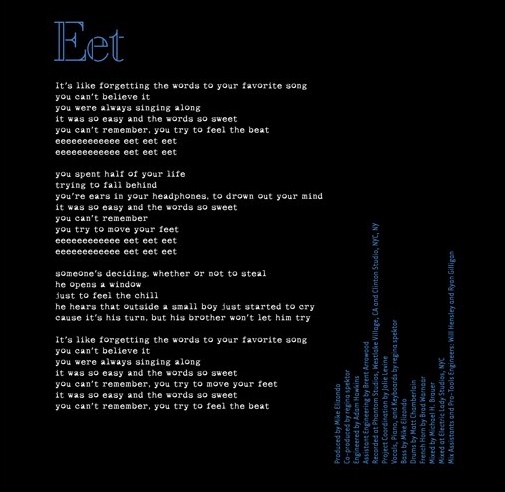
Here are the lyrics from the official booklet that accompanied the album. Read them as you listen:


She follows them to the letter.  The line I would most like to draw your attention to is the charmingly orthographically challenged: "you're ears in your headphones to drown out your mind".  You are not ears in your headphones, Regina.  Or are you? Maybe she's even deeper than I thought?  Would not surprise me.  But as a non-native English speaker who had different aspirations for her second language she has copped to not being spelling bee material in interviews so let's go with the interpretation that the line she intends us to hear is: your ears in your headphones.  Maybe it's because I devoured the booklet as I was learning the album that to this day that is the line I always hear her sing.

Which brings me to my point, because if you already sing the lyrics to yourself whenever you hear the song, the probability is almost 100% that I've just blown your mind.  For I have yet to find an unofficial lyrics site or a YouTube cover of any quality (and there are many of quality) in which that line is not rendered: "you're using your headphones".

Or maybe you've missed it again.  In the version Regina sings, the ears are clamped inside the innards of electronics equipment that serves to swamp the head the ears belong to in an embrace of escape from the barrage of words from the internal voice that will not shut up.  In the version every one else sings, the ears are missing altogether from the equation.  It's a subtle difference-- one that has almost no bearing on the literal meaning of the phrase-- but it's a difference.  "You're using your headphones to drown out your mind" is prose; "Your ears in your headphones to drown out your mind" is poetry.  This means that everyone who hears or performs the song Eet ever, is doing it wrong (wrong I say!), with the exception of 2 people (and, face it, I may be the only one of the two who actually cares).

End of story, right?  Wrong again!  For on Regina Spektor's latest album, Remember Us to Life, history is repeating itself. The song in this case is Grand Hotel, possibly among the greatest in her epic catalog:


The second verse is where the trouble lies:

 Under the floorboards, there's a deep well
That leads to a spring that sprung up in hell
That's where old devils danced and kissed
And made their blood pacts in the ancient mists

I did not buy the CD version of the album, just the download, but from what I can tell there is not an accompanying booklet for the CD or at least images of it are not readily available online.  In any case, I'm basing my certainty about this on my ears, on, again, the poetic sense of it, and -- I mean, come on!-- on my track record.  Nevertheless once again, the version of the last line that is proliferating on lyrics sites and YouTube videos is this:

And made their blood pacts in the ancient myths

While I could be wrong this time and everyone else right, I would be sad if that were so because the version I hear befits the song.  Once again: Ancient myths: prose, and tin-eared prose at that; Ancient mists: Poetry.

**********
Speaking of pacts ...  take some heart that much of the prevailing opinion from many of those still in the Paris Climate Agreement is that Trump out of the agreement might be somewhat better for the climate than Trump micromanaging in his typical cloddy inept fashion from within.  Vent, communicate, plan, push.  The agreement stands with or without.  The climate and the struggle to mitigate our effect on it will catch us on the flip.